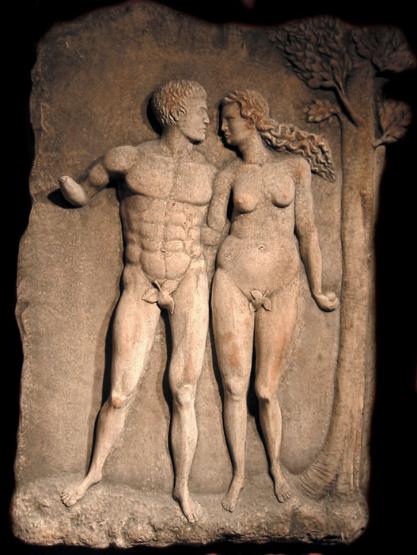
What does the egalitarian relationship of the Trinity have to do with being created in the image of God? And what implications does it have in regards to women in the pulpit?
Part 3: Humankind, the Imago Dei
“Then God said, ‘Let us make humankind in our image, according to our likeness; and let them have dominion over the fish of the sea, and over the birds of the air, and over the cattle, and over all the wild animals of the earth, and over every creeping thing that creeps upon the earth. So God created humankind in his image, in the image of God he created them; male and female he created them’” (Gen. 1:26-27 NRSV).
What does it mean that male and female are created in the image of God? Karl Barth elaborates on the image of God as male and female, and states that as God is one, “so man as man [humankind] is one and alone, and two only in the duality of his kind, i.e., in the duality of man and woman. In this way he is a copy and imitation of God.”[1] To restate it succinctly, Barth claims that the singularity of humankind in the distinctive plurality of male and female is the image of the one God who is distinctive in three persons. Clearly, male and female then are not individually images of God, but that communally, male and female comprise the imago Dei. As such, humankind—male and female—is to have dominion and exercise lordship.
“As many thinkers since Karl Barth have noted, this is a community-text. The image of God is a social rather than an individual concept. The clue to the social dimension of the divine image is present in the Genesis text itself. The narrator explicitly links the plurality of humankind, which includes a plurality of sexes, to a plurality found in the divine self-reference.”[2] Humankind is the image of the relational Trinity. The Triune God is not comprised of a hierarchy of one person over and above the other. The Trinity represents the self-giving and mutual love that exists between God the Father, God the Son, and God the Holy Spirit. It is an egalitarian relationship of love. Therefore, as there is no hierarchy in the relationship of the persons of the Trinity, there is no gender hierarchy in humankind created in the image of God.
The practice and teaching of excluding women from proclaiming God’s word and denying their call as preachers distorts the image of God in the church and contradicts what God said was “very good.” The church is to bear the image of God; therefore, there can be no gender discrimination in calling or in leadership roles. Men and women collectively represent the image of God, are equal before God, and equal to one another. Humankind is relational, and women and men are to live lives that express mutual love in community with one another. Just as the persons of the Trinity do not work independently, as the image of God, women and men both are to work together, even in the ministry of proclamation. Trinitarian theology does support women in the pulpit—a single gender cannot represent humanity as the image of God.
[1] Karl Barth, Church Dogmatics, vol. 3, The Doctrine of Creation, Part 1, ed. G. S. Bromiley and R. F Torrance, trans. J. W. Edwards, O. Bussey, and H. Knight (Peabody, MA: Hendrickson Publishers, 2010), 186.
[2] Stanley J. Grenz, Theology for the Community of God, 2nd ed. (Grand Rapids: William B. Eerdmans Publishing company, 2000), 175.


 Michelle Mosier
Leave a reply to Michelle Mosier Cancel reply